Sleep and breast cancer research at IPOS 2026.
 This November, three members of the Strathclyde Sleep Centre – Professor Leanne Fleming, Dr Stephanie McCrory, and Dr Declan M. McLaren – presented their research on sleep and breast cancer at the International Psycho-Oncology Society (IPOS) conference in Barcelona.
The patient–clinician implementation gap
Professor Leanne Fleming presented findings from the INVEST trial in her talk titled The patient-clinician implementation gap: why evidence-based sleep interventions are not reaching women following breast cancer diagnosis.
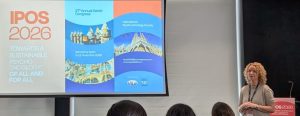
Professor Fleming shared the results of a recent process evaluation which explored the challenges related to delivering sleep restriction therapy for acute insomnia in people recently diagnosed with breast cancer.
Recruitment, in particular, was a key challenge, with the timing relative to diagnosis and cancer treatment, and limited clinical capacity among the main barriers. However, participants who did receive the treatment described how it provided a sense of structure and control, at an otherwise chaotic and uncertain time.
Exploring suitable treatments for secondary breast cancer patients with insomnia through stakeholder collaboration (ESTABLISH): A co-production approach.
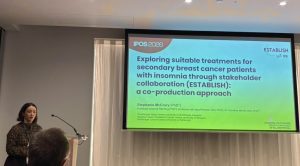 Dr Stephanie McCrory shared findings from her work on the ESTABLISH project. Through a series of co-production workshops, Dr McCrory and the ESTABLISH team worked with nine people with lived experience of secondary breast cancer and twelve healthcare professionals. Workshops explored how cognitive behavioural therapy for insomnia (CBT-I) should be delivered and adapted to meet the needs and preferences of people with secondary breast cancer who are living with insomnia. The adapted programme combines small-group sessions with individual check-ins and closer monitoring of fatigue and pain. In a small pilot, participants reported sleeping better and found the programme acceptable.
Investigating the value of early sleep therapy – Preliminary efficacy of sleep restriction therapy during treatment for breast cancer.
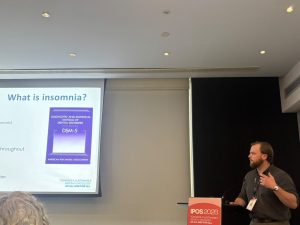
Dr Declan M. McLaren and the INVEST team delivered sleep restriction therapy to five women who developed acute insomnia after a diagnosis of primary breast cancer. Sleep diaries and questionnaires were used to monitor changes in sleep and wellbeing.
Results indicated that treatment was associated with improvements in sleep maintenance and anxiety. Four of the five women scored below the clinical threshold for insomnia on the Insomnia Severity Index (ISI) after treatment. Individual-level analyses allowed the research team to examine how changes in sleep coincided with cancer treatment, results appointments, and other contextual factors – insights which may have been missed were the data aggregated together.